Environmental action - 2026 TOP 10 SHORTLIST
Cabog-Cabog Integrated School
Balanga, Bataan, Philippines
The Philippine school using robotics and hydroponics to protect the future of farming communities
Cabog-Cabog Integrated School, a government kindergarten, primary and secondary school in Balanga, Bataan, Philippines, is placing environmental education at the centre of its “curriculum garden mapping’ learning model that has turned the school into a living laboratory where students blend ancestral agricultural knowledge with hydroponics, robotics, organic farming, and entrepreneurship. Perched in the rolling uplands approximately 10 to 15 kilometres from the town centre, the school serves children from low-income farming families whose livelihoods depend heavily on seasonal agriculture and livestock. Many learners face economic hardship and food insecurity, often leaving households with little choice but to send children to school hungry, which affects their ability to concentrate, engage and learn meaningfully.
To change this, the school has deliberately rebuilt learning around the realities of upland life. What began as a mandated school garden evolved into “TATAK KOMUNIDAD: Bayanihan para sa Gulayan ng Paaralan”, a whole-school environmental and learning ecosystem rooted in the Filipino spirit of Bayanihan, or communal unity. Through its curriculum, agricultural cycles are integrated directly into academic learning across multiple subjects.
The school garden acts as an outdoor classroom where students learn by doing. In science, they watch plants grow, study the environment, and record data. In maths, they measure plant height, calculate yields, and practice accounting skills related to farming. Through Technology and Livelihood Education (TLE), students learn about food processing, packaging, and entrepreneurship, and see how caring for the environment supports economic stability.
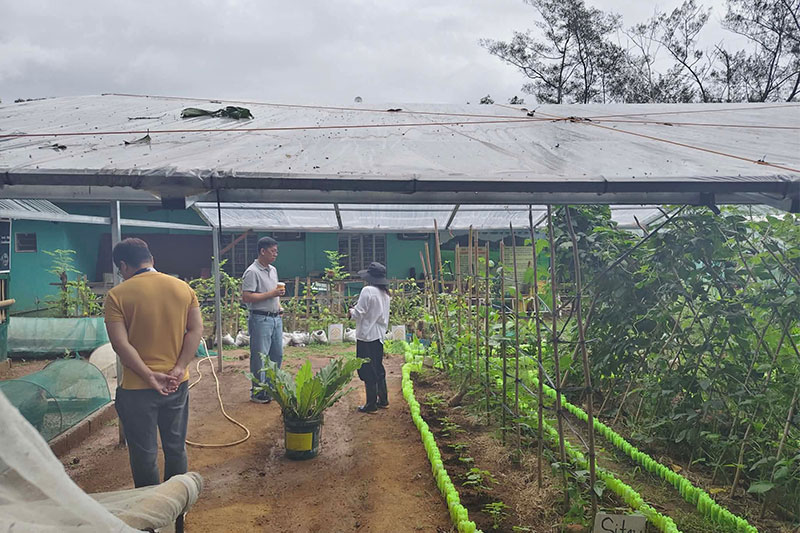
The programme also brings in advanced farming technologies that are not common in schools with limited resources. For example, students in the Special Science Elementary School (SSES) use hydroponics to learn about how plants work, nutrient solutions, water chemistry, and using resources wisely. They also explore ways to farm without soil, which helps in areas where erosion is a problem.
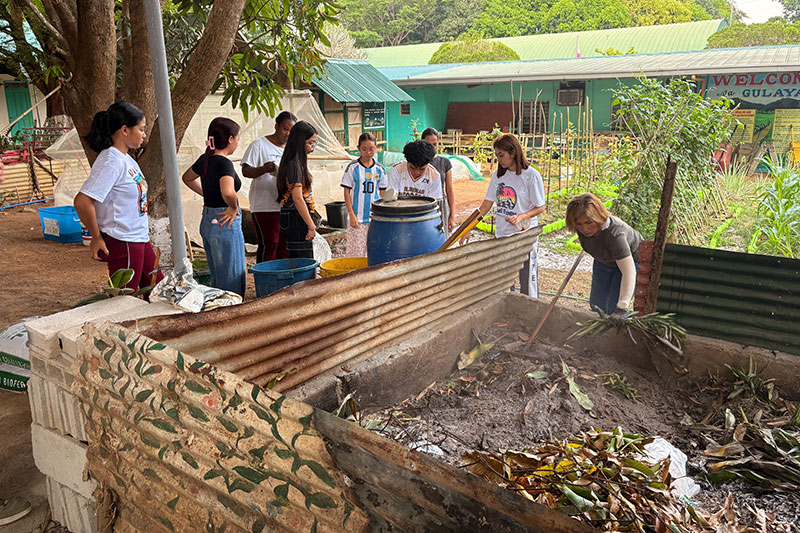
The school supports environmental sustainability by using circular economy ideas in daily activities. Working with families, local farms, and alumnus agriculturist Michael Grande, the school gathers animal manure and biodegradable waste from nearby farms and the canteen to make organic fertiliser. Rain-catcher systems help save water, and students learn directly about soil conservation, biodiversity, sustainable farming, and managing resources. By working with the City Environment and Natural Resources Office (CENRO), the school has also grown local vegetable varieties that now serve as a small genetic bank for the upland area.
Parents, especially those in the government’s Pantawid Pamilyang Pilipino Program (4Ps), help teach by sharing their experience with planting seasons, pest control, and farming methods. Community leaders, alumni, local officials, NGOs, and agricultural experts also support the school by giving donations, mentoring, technical training, and sharing resources.
One of the school’s most important partnerships is a 'School-to-Table' system with Sae Mul Gyul Mission Inc., Truth and Life. They buy vegetables straight from the school garden to use in daily feeding programmes for elementary students. This system helps improve student nutrition, gives the garden a steady market, and shows how caring for the environment, food security, and learning are all connected.
The impact of the model has extended across health, learning, sustainability, and community resilience. Among 44 elementary learners identified as “wasted” or “severely wasted”, 100% showed significant weight gain and improved attendance through the feeding programme, while 75% improved their academic performance. The school garden now provides approximately 40% of the fresh vegetable requirements for feeding initiatives, with surplus harvests supporting the canteen and local community sales. Through community support and income generated from the project, the school has also achieved approximately 99% self-sustainability for its hydroponics and robotics programmes without relying on government maintenance funding. Students involved in the hydroponics programme demonstrated a reported 15–20% increase in assessment scores across English, science, mathematics, TLE, and related subjects compared to baseline results.
Cabog-Cabog Integrated School has twice been inducted into the Hall of Fame in the Region III Gulayan sa Paaralan competitions, regularly earning scores above 96% for sustainability, productivity, and community involvement.


Check out our social media!